I'm going to stop posting on here shortly. Update your bookmarks; this website has been moved to wifeytini.com.
As always, I can be reached at wifeytini@gmail.com.

Thursday, May 8, 2014

What Spina bifida looks like (so far): An Update
A few weeks ago, the kids and I went to weekly Rosary, at our church. (In the interest of full disclosure, lest you think we are super holy or something, we showed up late and I knew about half the words to the Hail Holy Queen prayer. What I did remember sounded something like, "Hail, Holy Queen -- sit down! -- our life, our sweetness, and our hope. To thee -- sit on your bottom! Now! -- do we cry -- stop crying! -- poor, banished children of Eve -- just take this candy. EAT THIS CANDY AND BE STILL!
and et cetera.)
I was chatting it up with another woman afterward, and I casually mentioned something about Henry having special needs. (I don't know how these things come up in conversation. Honestly, whenever I'm first meeting someone, I just want to blurt out Henry has spina bifida! -- not because I think it's relevant, or that it defines him, necessarily. But because people are always shocked when we've been talking for a while and it inevitably comes up. I feel like I'm hoodwinking people. This woman was no exception.)
This woman was stunned. "Special needs?" She said, visibly taken aback. "What's wrong with him?"
"Not a thing," I said. "But he has Spina Bifida, so he has some mobility problems."
"He does?"
"Yeah, along with some other things. He has a shunt."
"What? You can't even tell!"
"I know, right?!"
These conversations never fail to make me laugh. I will never forget Henry's many ultrasounds, and hearing the words shunt and clubbed feet and multiple delays, and imagining myself giving birth to, well, some kind of creature. In utero, he seemed more like the sum of his various disabilities rather than an actual person. When I was pregnant, I desperately wanted a glimpse of what he would look like at birth, at six months, at one year. Would he be okay, in spite of his problems? Would be be deformed and eternally pitied?
And the ultimate question -- Will I be able to love him? Will other people?
Fourteen months later, you'd have to be insane not to love him. He's a butterball. He's incredibly social -- the opposite of June, who doesn't want anything to do with you if you don't have candy -- and constantly babbling, smiling, laughing. Amazingly, he has no cognitive delays so far. He is scoring ahead of his age, developmentally, in a few areas. What I would have given to know that when I was pregnant with him. The most common question people ask me is, how's Henry doing? I never know what to say, other than he's incredible, he's doing great. He's got some medical issues, obviously, but they're just such a small part of who he is, and they affect our day-to-day life so little, his good-natured, super strong personality just kind of eclipses all of that. He's just great.
But anyway. Because I so desperately wanted a "future preview" of sorts, when I was pregnant, I'm hoping to provide one now, for anyone else who is wondering how Henry's doing, and for anyone who is currently pregnant with an SB kid and wants to know what SB might specifically look like a little farther down the road. So given that Spina Bifida is a spectrum, and that all children look and develop differently, here is what Spina Bifida looks for us, 14 months out of the gate (and by "gate" I mean "vagina").
 |
| You're welcome, for that visual. Also, jk, I had a c-section. |
How can you tell he has Spina Bifida?
 |
| He was eight weeks old here, btw. |
Probably the most glaring defect Henry has is clubbed foot. By far, this was the thing that scared me the most when I was pregnant with him, other than the prospect of him being severely mentally handicapped (which, actually, is a rarity with spina bifida). The term "clubbed foot" sounds like such a horrible, grotesque anomaly. I had no idea they would be perfectly adorable baby feet that were turned inward. So not the nightmare that I was expecting.
Truth be told, we love these little hook-feet. He crawls all over the floor, and his little hook-feet catch various things and drag them across the floor with him. We're always having to chase him down and pluck things out from between his legs. They are ridiculously soft and smooth and precious.
People ask us often when we're going to "fix" his feet. The answer is June. We have a "tendon release" in his feet (::shudder::) and ponsetti casting scheduled for the first week of June -- we wanted to wait until he was able to use those muscles developmentally, with standing and pulling up and such, so that he would potentially have a better outcome. Is it crazy that I'm going to miss these tiny feet? Is it crazy that I look at other babies' feet and think, "Wow, those are so big and weird-looking! EW!"
 |
| WRONG. Give me little hooked parenthesis feet or give me NOTHING AT ALL. |
One thing that's been problematic is the lessened feeling below his knee. Since Henry has spinal cord damage, the feeling below his knee is limited. It's kind of hard to tell what he can feel, if anything: Sometimes I swear he can feel me tickling his feet. Other times, like in January, it doesn't look like there's much going on down there.
In January, I went upstairs to retrieve him from his nap, and what I found in his crib shocked me. Happy as a clam, Henry was lying there with blood all over his face. When I whipped back the covers, to my eternal horror I saw that he had blood smeared all over his legs, and his toes were a mangled mess.
 |
| Kinda like this only way less metal |
Turns out, after the husband and I stopped freaking out and calmed down enough to assess the situation, Henry was nibbling on his toes like any other baby would. Except that since he couldn't feel any pain or pressure, he just kept nibbling...and nibbling. So in our house, when Henry's cutting teeth, we stock up on socks, shoes, and a bunch of bandaids and antibiotics. Gross.
 |
| THOSE CHEEEEEKS |
Henry also has low trunk strength and limited hip flexion. You can see it a little bit in the picture above, how he's kind of leaning forward and folding in on himself (granted, he was like two months old in this picture, so he wouldn't really be sitting upright anyway). The lower trunk strength issues make him a little wobbly when he sits unassisted. The hip flexion problems make it difficult for him to stand upright.
Here's a super-scientific diagram of what I'm talking about:
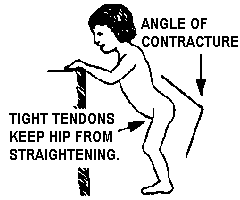
So basically, if Henry were to stand, he'd be sort of folded in on himself and standing at an angle, like a little old man using a walker. This is because of tight tendons in his hips, or something. We're trying to stretch out these tendons in physical therapy, but there's a small chance he might need surgery to "loosen" them. (::shudder::) Our hope is that he will be able to stand and walk, relatively unassisted. He does neither right now.
 |
| Limited hip flexion, limited trunk strength, and clubbed feet. But he's SOOOO CUUUUTE |
What he can do is amazing. No, he does not walk. Yet. No, he does not stand. (Although there are kids with SB I know who can stand at this point. Like I said, it's a spectrum.) BUT -- he's starting to pull up into a kneeling position (when I'm unloading the dishwasher and he tries to pull the knives out of the silverware rack). And best of all, he crawls all over the place. So quickly that at preschool this week, he crawled out the door and into the hallway three times before I found him and caught up to him. Dude is fast.
 |
| Crawling! Something we were told he'd never do. Take that, bitches! |
In summary, he's doing amazingly well, and I am so incredibly proud. This is what SB looks like for us at this moment in time.
Which is to say, better than I ever thought possible.
Which is to say, better than I ever thought possible.
Tuesday, May 6, 2014
As long as it's healthy. But what if it's not?
Six months into our pregnancy with Henry, after our bombshell diagnosis, Lou and I would make regular treks up to Park Ridge to see the Maternal-Fetal Medicine specialist, who kept us abreast on how the baby was doing in-utero. Since I'm ridiculously extroverted and I adore small talk, I started chatting up the receptionist as we were filling out some paperwork, post-appointment (Lou, his usual introvert self, was probably silently willing me to stop talking). At this point, we had already been told by two separate doctors that Henry would be totally paralyzed from the waist down.
We started talking about her kids -- three girls! -- and I asked her if she preferred girls, or if she might try for a boy. We both quickly agreed that sex wasn't really that important -- boy or girl, they were blessings.
"Oh, I like girls, but it doesn't matter to me!" she exclaimed. "You know, as long as they're healthy and running around!"

I felt it, and Lou felt it, simultaneously -- that hot knife of grief in the belly. I think he actually winced. I laughed, bewildered, and said something like, "LOL I KNOW RIGHT? HAHAHA OTHERWISE IT WOULD BE AWFUL, WOULDN'T IT, IF THEY COULDN'T WALK???" and then slumped back to the waiting room with my paperwork.
Later, on the ride home, Lou bristled. "She works for a maternal-fetal specialist," he grumbled. "What was she thinking? Healthy and running around? What the hell?"
That phrase has haunted me, ever since we found out that our child would be born with a birth defect. As long as it's healthy! People chirp at you, when you talk about finding out the gender. Boy? Doesn't matter! Girl? Who gives a shit! Nothing else matters but perfect health! And once you discover that your kid isn't healthy, it almost feels like a threat.
Because what if it's not healthy?
What then?
That phrase terrifies me. Because we're talking about our children -- an arrangement that's supposed to be unconditional -- and as long as they're healthy! is alarmingly conditional. Everyone's happy for a new baby and congratulations are in order -- but only under certain criteria. Right? And if baby doesn't meet that criteria, well, all bets are off. All the congratulations vanish. Your support system bottoms out from under you. People start whispering. Doctors start talking about going in another direction. Changing the course of the pregnancy. Disrupting the pregnancy. Termination. Because, clearly, if your child isn't picture-perfect, a SWIFT DEATH is preferable.
It's not wrong to want a healthy baby, don't get me wrong. Nobody prefers a medically fragile baby. Nobody wants to see her child suffer. So we wish for health. We make ominous, defensive, vague statements. Everything will be okay -- unless it's not!
Let's retire that phrase. Shall we?
It's time to stop putting health on a pedestal.
Is health important? Uh, yeah, duh. Is it the summit of our human experience? Is it the sole quality off of which we should determine the worth of our children? No.
We need to move past this fatalistic attitude we have that says a life with a disability is tragic and hopeless. We need to get over the idea that a handicapped baby is better off dead. We've had handicapped presidents, for God's sake. We've had handicapped olympic medalists. One of the most sought-after motivational speakers on the planet has neither arms nor legs, and I'll bet you a hundred bucks he's smarter and more physically active than I am. For the love of God, one of the most poetic and well-written books in existence was written by a man who could only blink his left eye.
And when we say as long as it's healthy!, we're negating all the unlimited potential we have as human beings. We don't need to be "healthy" to be heroic. And we shouldn't need to be able-bodied to be considered human beings.
And when we say as long as it's healthy!, we're telling parents that our support as a society is conditional. Have a healthy baby, and you're golden. Come back from your ultrasound with a special needs diagnosis, and we'll need to start discussing your options.

Come on, society. We're better than that.
We started talking about her kids -- three girls! -- and I asked her if she preferred girls, or if she might try for a boy. We both quickly agreed that sex wasn't really that important -- boy or girl, they were blessings.
"Oh, I like girls, but it doesn't matter to me!" she exclaimed. "You know, as long as they're healthy and running around!"
I felt it, and Lou felt it, simultaneously -- that hot knife of grief in the belly. I think he actually winced. I laughed, bewildered, and said something like, "LOL I KNOW RIGHT? HAHAHA OTHERWISE IT WOULD BE AWFUL, WOULDN'T IT, IF THEY COULDN'T WALK???" and then slumped back to the waiting room with my paperwork.
Later, on the ride home, Lou bristled. "She works for a maternal-fetal specialist," he grumbled. "What was she thinking? Healthy and running around? What the hell?"
That phrase has haunted me, ever since we found out that our child would be born with a birth defect. As long as it's healthy! People chirp at you, when you talk about finding out the gender. Boy? Doesn't matter! Girl? Who gives a shit! Nothing else matters but perfect health! And once you discover that your kid isn't healthy, it almost feels like a threat.
Because what if it's not healthy?
What then?
That phrase terrifies me. Because we're talking about our children -- an arrangement that's supposed to be unconditional -- and as long as they're healthy! is alarmingly conditional. Everyone's happy for a new baby and congratulations are in order -- but only under certain criteria. Right? And if baby doesn't meet that criteria, well, all bets are off. All the congratulations vanish. Your support system bottoms out from under you. People start whispering. Doctors start talking about going in another direction. Changing the course of the pregnancy. Disrupting the pregnancy. Termination. Because, clearly, if your child isn't picture-perfect, a SWIFT DEATH is preferable.
 |
| CLEARLY. |
Let's retire that phrase. Shall we?
It's time to stop putting health on a pedestal.
Is health important? Uh, yeah, duh. Is it the summit of our human experience? Is it the sole quality off of which we should determine the worth of our children? No.
We need to move past this fatalistic attitude we have that says a life with a disability is tragic and hopeless. We need to get over the idea that a handicapped baby is better off dead. We've had handicapped presidents, for God's sake. We've had handicapped olympic medalists. One of the most sought-after motivational speakers on the planet has neither arms nor legs, and I'll bet you a hundred bucks he's smarter and more physically active than I am. For the love of God, one of the most poetic and well-written books in existence was written by a man who could only blink his left eye.
And when we say as long as it's healthy!, we're negating all the unlimited potential we have as human beings. We don't need to be "healthy" to be heroic. And we shouldn't need to be able-bodied to be considered human beings.
And when we say as long as it's healthy!, we're telling parents that our support as a society is conditional. Have a healthy baby, and you're golden. Come back from your ultrasound with a special needs diagnosis, and we'll need to start discussing your options.
Come on, society. We're better than that.
Thursday, May 1, 2014
Baby Terror. And Agoraphobia Terror. And Just Plain Terror.
Lou can tell when I haven't been taking my zoloft, and his accuracy is alarming. It never ceases to astound me how totally chemical anxiety is.
Without getting too detailed, having another child is almost a physical impossibility for us at this point. We've decided we won't be having any more kids for some time, and knock on wood, there won't be one. But that doesn't stop me from peeing on a pregnancy test every single month, even though pregnancy is nigh-impossible and my husband is rolling his eyes in exasperation. There's no way we could be pregnant this month right? I ask, three times in a row, rapid-fire. Without fail, he raises his eyebrows in a 'you're insane' way. No, he says. Have you taken your zoloft? So there you go.

But I can't help it. I think it's how your hormones shift after you ovulate. A doctor drew it for me on a napkin once, after I told her that during ovulation, I feel amazing. Great! Stable! No anxiety here! Depression? What's that? And then a week later, I am hyperventillating, crying, obsessing, and generally wanting to hide in a hole.
Go figure that your hormones (progesterone, I think? And estrogen) plummet after you ovulate. And when your hormones plummet, you start to feel like shit. Your anxiety (or depression, or both) comes back in full force. You go from thinking, hey, life is pretty great! to over-analyzing completely everything. When I'm ovulating, I think, you know, having another baby wouldn't be so bad. Maybe in a year or so...? We're in a good place right now. A week later, I think of having another baby and my heart starts pounding. Oh Jesus no, I think, no no no, please don't send me another baby, I couldn't mentally handle it.
Truth be told, another BABY wouldn't be so bad. Pregnancy and birth are what I hate. I have an intense fear of vomit and some vestiges of medically-related PTSD that makes birth and pregnancy a whirlpool of uncontrollable anxiety. A pregnancy without antidepressants is not possible for me, but now that I've had a child with a neural tube defect, I'm so terrified of taking anything during pregnancy, in case it was a medication that caused it. I start skipping my zoloft after I ovulate -- you know, on the near-impossible chance that we actually did concieve a baby and on the premise (which is not evidence-based, by the way) that the zoloft actually caused his NTD somehow. Anyway, I'm terrified. And the terror convinces me to skip a dose or two. Which makes it worse. Which means until I start getting some mad therapy (and until we get, like, our own house, obviously), there are no babies on the horizon.
If it were morally licit and I had a zillion dollars, I would totally have a test tube baby. No vomiting for months on end. No danger of me poisoning the baby with my very-much-needed antidepressants. No painful, terrifying birth. No danger of a post-partum hemorrhage. I would have like ten test-tube babies. I would have my own Jurassic Park full of test tube babies.
So it's with alarming accuracy that Lou can tell whether or not I've been taking my meds. I start sounding a little bit like Shoshanna from GIRLS, hyper and fast-talking. I start talking over and over about things I can't control and I start imagining worst-case scenarios. An example: I was pinning away on Pinterest the other night, dreaming of having our own condo and what it might look like. For some reason, people like to pin pictures of trap doors in houses - trap doors under the stairs, hidden rooms behind bookcases, that kind of thing. I'll admit it's pretty cool, but when I haven't taken my zoloft that day, I start imagining myself as a Jewish woman in 1930s Germany, cowering with my children while Nazis tear through the house. Or I imagine I'm Jodi Foster in Panic Room, and I have to corral my child in a safe room while intruders try to coax us out. Basically, I start running through a billion scenarios in my head where my children are in danger and I have to protect them. And then my heart starts pounding. And I have to shut off the computer, take my medicine, and go to bed. All because of this:
I also, ever since being diagnosed with PTSD, have struggled mightily with agoraphobia. When I skip a few days of my zoloft, and then convince myself I'm miraculously pregnant, and then skip more zoloft so I don't poison my imaginary baby, and so on, and so forth until I'm literally incapacitated by anxiety, it is hard -- nay, impossible -- for me to leave the house. This was a phenomenon I never really understood until a counselor sat me down, opened up the DSM-V, and showed me the part of the book where it spelled out explicitly what agoraphobia is. I half expected to see my picture next to the description.
Avoidance? Well ... I only avoid class because there might be a shooter or something. And I avoid Devon Avenue because it reminds me of India. And I can't walk to CVS without a buddy because there might be a stabber on the loose. But other than that, I'm cool!
Restricted Travel? Not really. Except I haven't been able to take the train in three months without a panic attack. And I'm late for class every day because once I muster up the courage to go to class, I have to walk three miles to get there. That's normal, right?
Fear of being confined? Uh, duh! If I'm confined, I can't escape if there's a shooter!
I can safely say I no longer have PTSD. But I very much still struggle with agoraphobia. Even with medicine, it is hard for me to voluntarily leave the house. I can't tell you how many times we miss Wednesday Rosary at church because Henry pooped his diaper twice this morning and he might do it again when we're out! or June is potty-training and she'll pee everywhere! or there might be rain -- the sky is cloudy!. It's not logical. It doesn't make sense. But, I guess, the anxiety I have makes me have an incredibly low tolerance for anything surprising, or unplanned, or anything from whence I can't immediately flee. At the height of my PTSD, I couldn't ride in a car because if I had to pee while I was driving, I couldn't immediately get out and pee. I would have to wait and find a gas station or something first. That terrified me. Legitimately. One night, on our way to a friend's party, I suddenly had to pee while we were on the highway, and we had to drive around looking for an exit, trying to find a Burger King where I could relieve myself. We found a gas station within fifteen minutes, but by then I was a sobbing, hysterical, hyperventillating mess. Because what if I had peed my pants?
Believe me, it doesn't make sense, and I lived through it. That's the funny thing about anxiety. Your brain takes situations that, to anyone's right mind, are no big deal. Wearing a dress. Riding in a car. Going to Wednesday Rosary. And it takes those situations and warps and perverts them until they become insurmountable obstacles. You start thinking this dress is too tight! I'm gonna asphyxiate and die! I have to pee and I have to find parking before I get out of the car! I'm gonna have to hold in my pee forever and I'll die of uremic poisoning! And on. And on. Until you're a crying mess.
By the way, the anxiety is never really about being in a dress or going outside. The anxiety is about things happening that you can't control. The anxiety is about the fear of having a panic attack. It just feels like you're freaking out about something mundane.
Even worse, sometimes anxiety manifests itself as a physical sickness. Ever wonder why people go years and years with untreated anxiety or depression? It's because sometimes anxiety or depression doesn't look like a humorous personality quirk. Sometimes, back in college, I would start coming down with the flu. Achey limbs, runny nose, sore throat, headache. And then I'd cancel my plans and all my flu symptoms would go away in an hour. That's weird, I thought, and thought nothing of it. It took years and years to realize that, oh, this feels like the flu, but it's not really. It's kind of like having a twinge in your stomach and then finding out it's cancer. It kind of tilts your world on its axis.
Anyway. I guess my point is that it doesn't matter what your triggers are. Anxiety triggers look different for everyone. And they only very tangentially make sense. And your anxiety symptoms will probably not look like the next person's. And they might change over time, as well. (Ask me about the time I developed Irritable Bowel Syndrome and I couldn't go anywhere without the fear of crapping my pants! Actually ... don't ask me.)
But my point is that anxiety is debilitating. And elusive. And it makes you crap your pants.
And all you can do about it is suck it up, take a deep breath, and try your best to make it to Wednesday Rosary. Even if June pees her pants on the way there.
And get some zoloft. Sweet, sweet zoloft.
Without getting too detailed, having another child is almost a physical impossibility for us at this point. We've decided we won't be having any more kids for some time, and knock on wood, there won't be one. But that doesn't stop me from peeing on a pregnancy test every single month, even though pregnancy is nigh-impossible and my husband is rolling his eyes in exasperation. There's no way we could be pregnant this month right? I ask, three times in a row, rapid-fire. Without fail, he raises his eyebrows in a 'you're insane' way. No, he says. Have you taken your zoloft? So there you go.
But I can't help it. I think it's how your hormones shift after you ovulate. A doctor drew it for me on a napkin once, after I told her that during ovulation, I feel amazing. Great! Stable! No anxiety here! Depression? What's that? And then a week later, I am hyperventillating, crying, obsessing, and generally wanting to hide in a hole.
Go figure that your hormones (progesterone, I think? And estrogen) plummet after you ovulate. And when your hormones plummet, you start to feel like shit. Your anxiety (or depression, or both) comes back in full force. You go from thinking, hey, life is pretty great! to over-analyzing completely everything. When I'm ovulating, I think, you know, having another baby wouldn't be so bad. Maybe in a year or so...? We're in a good place right now. A week later, I think of having another baby and my heart starts pounding. Oh Jesus no, I think, no no no, please don't send me another baby, I couldn't mentally handle it.
Truth be told, another BABY wouldn't be so bad. Pregnancy and birth are what I hate. I have an intense fear of vomit and some vestiges of medically-related PTSD that makes birth and pregnancy a whirlpool of uncontrollable anxiety. A pregnancy without antidepressants is not possible for me, but now that I've had a child with a neural tube defect, I'm so terrified of taking anything during pregnancy, in case it was a medication that caused it. I start skipping my zoloft after I ovulate -- you know, on the near-impossible chance that we actually did concieve a baby and on the premise (which is not evidence-based, by the way) that the zoloft actually caused his NTD somehow. Anyway, I'm terrified. And the terror convinces me to skip a dose or two. Which makes it worse. Which means until I start getting some mad therapy (and until we get, like, our own house, obviously), there are no babies on the horizon.
If it were morally licit and I had a zillion dollars, I would totally have a test tube baby. No vomiting for months on end. No danger of me poisoning the baby with my very-much-needed antidepressants. No painful, terrifying birth. No danger of a post-partum hemorrhage. I would have like ten test-tube babies. I would have my own Jurassic Park full of test tube babies.
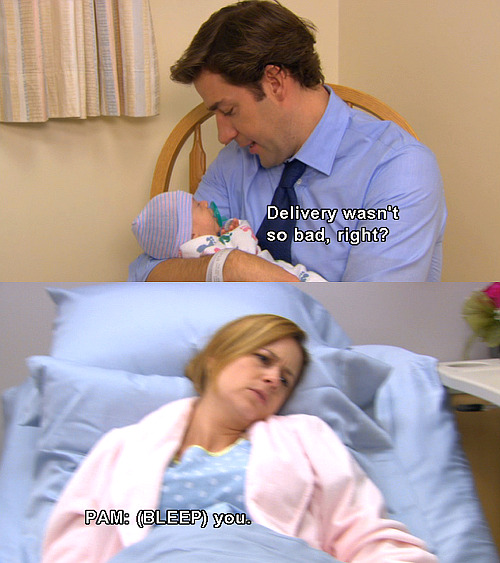 |
| Literally a conversation my husband and I have had, post-delivery. |
So it's with alarming accuracy that Lou can tell whether or not I've been taking my meds. I start sounding a little bit like Shoshanna from GIRLS, hyper and fast-talking. I start talking over and over about things I can't control and I start imagining worst-case scenarios. An example: I was pinning away on Pinterest the other night, dreaming of having our own condo and what it might look like. For some reason, people like to pin pictures of trap doors in houses - trap doors under the stairs, hidden rooms behind bookcases, that kind of thing. I'll admit it's pretty cool, but when I haven't taken my zoloft that day, I start imagining myself as a Jewish woman in 1930s Germany, cowering with my children while Nazis tear through the house. Or I imagine I'm Jodi Foster in Panic Room, and I have to corral my child in a safe room while intruders try to coax us out. Basically, I start running through a billion scenarios in my head where my children are in danger and I have to protect them. And then my heart starts pounding. And I have to shut off the computer, take my medicine, and go to bed. All because of this:
 |
OH JESUS, YOU CAN TOTALLY SEE THE HINGES, THE NAZIS WILL FIND US
|
Avoidance? Well ... I only avoid class because there might be a shooter or something. And I avoid Devon Avenue because it reminds me of India. And I can't walk to CVS without a buddy because there might be a stabber on the loose. But other than that, I'm cool!
Restricted Travel? Not really. Except I haven't been able to take the train in three months without a panic attack. And I'm late for class every day because once I muster up the courage to go to class, I have to walk three miles to get there. That's normal, right?
Fear of being confined? Uh, duh! If I'm confined, I can't escape if there's a shooter!
 |
| This would be the picture they'd include, by the way. Because CRAZY EYES! |
Believe me, it doesn't make sense, and I lived through it. That's the funny thing about anxiety. Your brain takes situations that, to anyone's right mind, are no big deal. Wearing a dress. Riding in a car. Going to Wednesday Rosary. And it takes those situations and warps and perverts them until they become insurmountable obstacles. You start thinking this dress is too tight! I'm gonna asphyxiate and die! I have to pee and I have to find parking before I get out of the car! I'm gonna have to hold in my pee forever and I'll die of uremic poisoning! And on. And on. Until you're a crying mess.
 |
| Whoever drew this knows what's up. |
By the way, the anxiety is never really about being in a dress or going outside. The anxiety is about things happening that you can't control. The anxiety is about the fear of having a panic attack. It just feels like you're freaking out about something mundane.
Even worse, sometimes anxiety manifests itself as a physical sickness. Ever wonder why people go years and years with untreated anxiety or depression? It's because sometimes anxiety or depression doesn't look like a humorous personality quirk. Sometimes, back in college, I would start coming down with the flu. Achey limbs, runny nose, sore throat, headache. And then I'd cancel my plans and all my flu symptoms would go away in an hour. That's weird, I thought, and thought nothing of it. It took years and years to realize that, oh, this feels like the flu, but it's not really. It's kind of like having a twinge in your stomach and then finding out it's cancer. It kind of tilts your world on its axis.
Anyway. I guess my point is that it doesn't matter what your triggers are. Anxiety triggers look different for everyone. And they only very tangentially make sense. And your anxiety symptoms will probably not look like the next person's. And they might change over time, as well. (Ask me about the time I developed Irritable Bowel Syndrome and I couldn't go anywhere without the fear of crapping my pants! Actually ... don't ask me.)
But my point is that anxiety is debilitating. And elusive. And it makes you crap your pants.
And all you can do about it is suck it up, take a deep breath, and try your best to make it to Wednesday Rosary. Even if June pees her pants on the way there.
And get some zoloft. Sweet, sweet zoloft.
Wednesday, March 19, 2014
A day in the life of a mom and a wife
Look. If I have to read one more debate about stay-at-home mothers (SAHMs) and Working Mothers and who works harder and sacrifices more, I'm going to puke.
SAHMs work hard. Working Moms work hard. Everyone works hard in different ways. Why is THIS the conversation I keep seeing over and over again in the blogosphere. Can we move on now?
Even less do I like the self-congratulatory treacle I keep seeing on the Huffington Post and my Facebook news feed -- letters from SAHMs to working moms, and vice versa, about how amazing the other one is, and how hard they work. You're the best! No, YOU'RE the best! YOU work harder -- no, YOU do!
 |
| Ugh. Like, who farted, right? |
Can we quit blowing each other for a minute? How about we agree that moms are moms, and different methods of mothering have different advantages and disadvantages. Both have their unique challenges. Why do we need to quantify these challenges, and debate them, and dissect them endlessly? I don't know about you, but I have a hard enough time getting them dressed and halfway presentable in time for preschool. I'm not going to concern myself with which mom is working harder, and who deserves more praise, and why.
 |
| Whether you work outside the home or not, you deserve one of these. |
I stay at home with my two children, Henry (12 months), and June (2.5). I fully acknowledge that I'm very privileged to be able to do so. I will also fully acknowledge that it's hard, and grueling, and sometimes I'm so desperate for grown-up conversation, I want to gnaw my own arm off so I can chat with the paramedics. It's hard. It's boring. Is it harder than going to the office and picking your kid up from daycare every day? I don't know. I suspect not. And what does it matter?
 |
| I mean, that would be sweet, though. Don't get me wrong. |
So. I'm not going to sit here and try to make the case for being a SAHM or a Working Mom. All I can present to you are the facts. I'm a SAHM, and here is how I spend my day. You can judge for yourself. Or not. Here we go:
 |
| Who run the world? These people. |
7:40 AM: Change June's diaper and put her in underwear. Change her underwear approximately four times because she can't decide between Dora and Hello Kitty.
7:50 AM: Run around getting breakfast for both children. Usually a colorful array of berries, bananas, and dry cereal, which is then smeared into a collage on their clothes, floor, seat, and walls.
8:20 AM: Inhale some food and check e-mail until one of the children start throwing food on the floor, signifying that they are finished eating. Clean the children and strip them down so I can wash all the berries and crusty cereal out of their clothes and hair.
8:30 AM: End up completely bathing them in the kitchen sink. Throw all the berry-smeared clothes, the high chair covers, and the towels in the washing machine.
9:00 AM: "Oops, Mommy, I think I have to go --" Clean up puddle of piss on the floor. Clean up piss footprints leading into the bathroom. Clean up piss-soaked Dora The Explorer underwear that June threw in the sink, for some god damn reason. Bleach the sink. Wipe down the toddler's piss-streaked legs and feet. Grab a random pair of underwear out of the diaper basket and ignore the shrieks of protest. NO MOMMY NO MOMMY I WANTED HELLO KITTY!!! HELLO KITTY MOMMY! DORA IS A BAD IDEA!!! Yeah, well, so was your conception, I want to fire back. Throw the piss undies in the washing machine.
 |
| I usually start praying fervently right about now. |
10:45 AM: Time to catheterize Henry again. Henry, in case you aren't a regular reader, has some special needs, due to being born with Spina Bifida Myelomeningocele. The only special need of his that really affects us on a day-to-day basis is that he needs to be catheterized four times daily. Catheterization is really no big deal. Basically, we stick a pee-tube in his wiener and empty his urine into his diaper so he won't have to overwork his bladder or something. I would link a YouTube video showing how it's done, but I don't want to get put on some list. Think of it as threading a needle: We stick a tube in, pee drains out, and then we take out the tube. Simple.
 |
| Exactly like threading a needle. Except with pee squirting everywhere. |
What's not simple, however? Trying to navigate the pee-tube up his pee-hole while he's twisting and turning to get away from me. So a procedure that should take about thirty seconds somehow turns into a five-minute wrestling match, Henry writhing on the floor and trying to crawl off into the other room somewhere, while I'm pinning his arms down with my legs and swearing quietly so June won't hear. I give him my phone to play with so he holds still, and make a mental note to wipe the pee off of it later.
11 AM: Time for naps. Children won't nap. This isn't how it happens with my Sim family. Try to comfort them in vain.

Tell June for the hundreth time she can have cereal after she takes a good nap -- because God forbid she'd have to wait more than an hour between eating. Comfort her when she cries I NEED CEREAL I'M SO HOOONNNGRY like she lives in a Sudanese refugee camp. Take her out of the room and change her diaper so Henry won't have to hear her yelling about being hungry. Hold June down with your arms and legs and forcibly strap a diaper on her, ignoring her cries of I DONT YIKE DIAPERS, I NEED DORA UNDIES. Drag June back into the nursery and dump her on the bed. Pat Henry on the head absentmindedly while he tries to writhe his way out of his swaddling blanket. Praise Jesus and all the angels and saints when they both stop crying and drift off to sleep. Eventually.
11:30 AM - 1:30 PM: Go downstairs. Half-heartedly fold a basket of laundry and leave the clean clothes sitting in the basket for the next six days. Shove some granola in your mouth as a snack. Join the children in their room and sleep like the dead.
2:00 PM: Henry wakes up. Time to cath him again. Tell Henry to stop being such a douchebag and hold still; make a mental note to go to confession.
2:05 PM: June wakes up. Change her back into Dora underwear.
2:06 PM: Prepare lunch.
2:08 PM: "Mommy, I smell poop! It's coming from my butt!" Clean up poop smears on the floor. Empty out June's poop-filled underwear. Gather the poop-streaked toilet paper ("I wiped myself, mommy!") and dump it into the toilet. Bleach everything. Wash hands. Multiple times.
2:30 - 4:00 PM: Feel incredibly, insanely guilty that you've spent all day running around laying out crafts for June and changing her underwear while Henry has been digging through the recycling and eating cereal off the floor. Play on the floor with Henry. Revel in how beautiful and intelligent he is. Read stories to him. Lovingly pry his hands from your head when he wants to pull your hair. Alternate between paying Henry attention and paying June attention, as they are both competing fiercely for it.
4:00 PM: Put on Daniel Tiger's Neighborhood and let both kids watch like six episodes. Lay on the floor and pretend to do yoga but really take a mom-nap.
4:30 PM: Remember you forgot to defrost something for dinner. Crap.
4:31 PM: What can I make for dinner? Text Lou: can we order pizza for the third time this week? No? Allrighty then.
4:32 PM: BAKED POTATOES. I AM GENIUS.
4:33 PM: Throw a few baked potatoes in the oven and set it to 400 degrees. Bam. Dinner served.
4:35 PM: Run around cleaning up clutter, sweeping, wiping down counters, shoving more berry-smeared clothes in the washing machine, and throwing sippy cups in the dishwasher so the house is some semblance of clean before Lou walks in the door.
5:30 PM: Take the kids on a walk around the neighborhood. Yell exercise time, exercise time! Yay! Mmm -- smell that fresh air?! Ignore how the kids are clamoring to get back inside the house. Walk two blocks and then come back.
5:45 PM: Shove the children into Daddy's arms the minute he comes through the door. Collapse on the couch and tell all of them you're going to check some VERY IMPORTANT E-MAILS and demand that they not disturb you, as you are VERY BUSY and IMPORTANT. Proceed to check Facebook while ignoring their cries for dinner.
6:00 PM: Realize you've burned the baked potatoes. Order pizza.
7:00 PM: Serve pizza to starving children. Strip off their sauce-laden clothes and throw them in the washer on top of their berry-and-cereal-smeared clothes. Catheterize Henry. Rinse June off in the sink. Diaper them both. Clothe them both. Carry them up into our bed, where they both insist on sleeping, and dump them there. Tuck them in lovingly and then run the hell out of there before they can protest.
7:30 PM: Collapse on the couch. Watch maybe one episode of The Wire before starting to fall asleep. Go back up to your room and watch your children sleep quietly. Stroke their hair and kiss their eyelids. Thank God for these precious gifts. Resolve to do better tomorrow. Resolve to be the mom they deserve.
7:35 PM: Polish up your resume. You know, just in case.
Tuesday, February 18, 2014
Underlying Depression
This is the fifth part in a series about PTSD, anxiety, trauma, and depression. This is the part about depression. Obvs. Read this post to catch up.
I didn't even realize I had depression until I was in the thick of it.
It was my senior year of college. I was going to school full-time, working part-time, and going to therapy once a week where I was in the midst of processing some really traumatic shiz. It was January, and I had started taking an SSRI for the first time in November, to combat my extreme anxiety and PTSD. It did nothing at first. And then -- it kicked in. And it felt like my prayers had been answered.
The antidepressants worked. They worked so well. Instead of a constant hypervigilence, I felt normal, calm, that relaxed feeling you get after a hot shower or a deep-tissue massage. After a year of constant anxiety, I practically buzzed with happiness. I felt like I could breathe again. Why didn't I start these earlier? I asked. I could talk about India without being massively triggered. I could walk to campus, hear car horns honking, and not suffer major panic attacks and have to turn around and hide out in my room. It was like I had a new lease on life.
And then, I think, the antidepressants worked too well.
The paralyzing depression snuck up on me. I noticed that I was taking more naps. I was slowly more sluggish. It was harder to get out of bed in the mornings. But I attributed that to working, school, and "writing my trauma narrative," as the counselor called it. I was physically and emotionally spent.
Slowly, throughout the month of January and February, I would come home from class and just zonk out for hours. I had a 3 hour writing workshop -- my favorite class -- and I would come home in the afternoon and sleep well into the evening. My counseling session was every Friday, and I would come home at noon and routinely sleep until four or five in the afternoon. Even if I just felt like I could take a quick cat-nap, I would wake up and five hours would have passed. Even if I didn't even feel all that tired. It's like I would just lapse into a small coma every day, and wake up feeling like I could keep sleeping. Maybe if I had known more about depression, I would have suspected it. But to me, depression was just "feeling sad." It was that little cartoon bubble with a frowny face and a cloud following him around. But I didn't feel like a sad cartoon bubble. I didn't feel "hopeless" or "unmotivated." I didn't even particularly feel tired. I just kept sleeping. And sleeping. And sleeping.
On the contrary, I felt really good. Kind of sluggish. Kind of groggy. But hell, after the year of heart palpitations, of extreme anxiety, of hypervigilence, feeling "kind of sluggish" and "unusually relaxed" was a welcome reprieve. I'm probably napping so much because of the zoloft, I thought, but hell, between crippling panic attacks and a few naps here and there, I'll take the naps. And then again, it could have been the hectic work/school/therapy schedule. Who knew? I brushed it off. And kept brushing it off.
For the life of me, I didn't realize it was depression. Or maybe I just slept a lot, because of the medicine, and that triggered the depression. But either way, I wasn't sad. I felt amazing, and relaxed, better than I had in the past year. But more and more, I started to love my bed. Not in a I-dont-have-the-will-to-live kind of way; Not even in an I-feel-so-tired way. I just craved being in my bed. I craved it like a big, fluffy, delicious sandwich. It was warm and soft and my pillow was just the right firmness, and I had just purchased an electric blanket that made nap time downright heavenly. So for whatever reason, I just became really attached to nap time. I'd look forward to it all day. I'd wake up in the morning, go to class, and count down the hours until nap time. And then when I'd come home and fall into my bed-haven, thinking, I'll just nap for twenty minutes, I would open my eyes and four hours would have passed. I hadn't even been tired!
Soon enough, I started sleeping through class. I would set an alarm and wake up seeing that it had been blaring for hours. That's weird, I thought, and set the alarm for different frequencies, different volumes. I would sleep through most of them. I started sleeping later and later in the mornings, and taking naps earlier and earlier. And for longer. I missed more and more class. I got farther behind, try to catch up, and get really quickly overwhelmed and want to take a nap. And the more class I missed, the more overwhelmed I got. And the more overwhelmed I got, the more I kept on napping. And the more I napped, the more I felt like I couldn't leave my bed. I felt stuck there. It was comfortable, and warm, and sleeping felt so good. I felt high off sleep.
I don't remember when the weird crying spells started. I would go to class and just come back home and randomly cry. I wasn't even crying about anything in particular -- nothing that I recognized, anyway. I wasn't particularly sad, and I didn't cry because I was triggered by anything specific I would have a good day in class and then just come home and burst into tears and sleep. Well, that's weird, I would think, but I attributed it to PMS. Or stress. Or maybe it was the zoloft? But between debilitating anxiety and a few crying jags here and there, I'd take the crying jags. I made a mental note to call the doctor -- after I took a quick nap.
Crying takes a lot out of you. I'd come home, cry for no reason, get super exhausted from crying, and take another four-hour nap. I spent a few months like that, and suddenly I realized I wasn't getting out of bed much at all. And showering? That required you to stand. For a long time. Homie don't play that. I was tired. From crying. Who had the energy to stand? Sure, my hair looked greasy as hell, but who did I have to impress? Who cared? Washing my hair would require lifting my arms, and my arms were tired. I'd take a shower later -- right after a quick cat nap.
Slowly, it progressed. More naps, more crying, less socializing, less leaving the apartment. But I wasn't having anxiety attacks anymore, so it was all good!
Depression is so full of shame. I don't remember when, or why, but I very slowly became morbidly fascinated with death. It was confusing -- I wasn't suicidal. I didn't want to die. I loved life. I was happy -- aside from the random crying jags. I was excited to get married in a few short months -- if I had the energy to make it down the aisle, that is. But for whatever reason, I wanted to know what death felt like. What it would look like. What I would look like, if I died. How would I do it, if I could choose? It wasn't an obsession at first. Just a casual curiosity. I found myself mulling over it more and more. What would happen to me? I mean, physically? If I hanged myself, how would my face look? Bruised? Bloated? These thoughts disgusted and shamed me -- even now, they disgust and shame me. I didn't (and still don't) want anyone to think I was weird, that I was deviant. I didn't want anyone to think I was unhappy or planning to die. I wasn't. But I just kept thinking about it. What would people think if they knew I was imagining myself hanging in my bathroom? If I told someone, would they have me committed? Would I get put on some list? Would they "flag" my medical file? (Is that a thing?) I didn't want to find out. I tried to push the thoughts out of my head. It didn't matter anyway, I told myself. I wasn't suicidal. I didn't want to die. I just ... wanted to imagine that I was dead.
Soon, it was all I could think about. I would have Googling sessions that lasted for hours, when I was supposed to be writing papers or studying, where I would just google graphic images of plane crashes. I didn't like these images -- I just wanted to see them. It was like a little game -- what was the most graphic image I could view, without wanting to shut down my computer? I didn't get very far, admittedly. I was terrified of gore. But the non-gory stuff I was all over. For hours, I listened to cockpit recordings of planes that had gone down. I wanted to hear the pilot's last words. I wanted to imagine how it felt. How did it feel to die? How did the pilots feel in those last minutes, knowing that death was inevitable? I had heard, in my own family, of people beckoning toward the sky in their last moments before dying. Had the people on these planes experienced that too? The cockpit recordings disgusted me, calmed me, and thrilled me, all at once.
I googled 9/11 a lot. I listened to 911 dispatches. I was horrified. But I kept seeking it out. I kept imagining myself on those planes. I omitted this when I saw my therapist -- I knew it wasn't really considered a suicidal ideation unless I had a plan to kill myself. And I didn't. Not exactly. Did I? I mean, I had thought about it a lot. And I had decided that hanging -- no, pills -- would be the way to go. But I didn't want to die. Did I? I mean, I didn't want to die, but I also spent a lot of time thinking about death. And I didn't feel sad ... but I also spent a lot of time crying inconsolably. It was all just very overwhelming. And you know what helped that overwhelming feeling? Naps.
I don't know if I had a "bottom" -- some low point that made me realize I needed to get help. But I remember one day I googled the phrase I can't stop thinking about suicide and a suicide survival forum popped up. I made a username and posted on it. Please help me, I posted. I'm not suicidal, I don't think, but I keep thinking about suicide. I can't stop. I can't think about anything else. I can't get out of bed. Does this mean I'm suicidal? I don't want to die, but I just can't stop thinking about it. What do I do?
The response was overwhelming: You're depressed, dummy. Get to the doctor. NOW.
And I did.
I didn't even realize I had depression until I was in the thick of it.
It was my senior year of college. I was going to school full-time, working part-time, and going to therapy once a week where I was in the midst of processing some really traumatic shiz. It was January, and I had started taking an SSRI for the first time in November, to combat my extreme anxiety and PTSD. It did nothing at first. And then -- it kicked in. And it felt like my prayers had been answered.
The antidepressants worked. They worked so well. Instead of a constant hypervigilence, I felt normal, calm, that relaxed feeling you get after a hot shower or a deep-tissue massage. After a year of constant anxiety, I practically buzzed with happiness. I felt like I could breathe again. Why didn't I start these earlier? I asked. I could talk about India without being massively triggered. I could walk to campus, hear car horns honking, and not suffer major panic attacks and have to turn around and hide out in my room. It was like I had a new lease on life.
 |
| Gonna eat some dinner without worrying I'll get botulism and die. Take that, anxiety! |
And then, I think, the antidepressants worked too well.
The paralyzing depression snuck up on me. I noticed that I was taking more naps. I was slowly more sluggish. It was harder to get out of bed in the mornings. But I attributed that to working, school, and "writing my trauma narrative," as the counselor called it. I was physically and emotionally spent.
Slowly, throughout the month of January and February, I would come home from class and just zonk out for hours. I had a 3 hour writing workshop -- my favorite class -- and I would come home in the afternoon and sleep well into the evening. My counseling session was every Friday, and I would come home at noon and routinely sleep until four or five in the afternoon. Even if I just felt like I could take a quick cat-nap, I would wake up and five hours would have passed. Even if I didn't even feel all that tired. It's like I would just lapse into a small coma every day, and wake up feeling like I could keep sleeping. Maybe if I had known more about depression, I would have suspected it. But to me, depression was just "feeling sad." It was that little cartoon bubble with a frowny face and a cloud following him around. But I didn't feel like a sad cartoon bubble. I didn't feel "hopeless" or "unmotivated." I didn't even particularly feel tired. I just kept sleeping. And sleeping. And sleeping.
On the contrary, I felt really good. Kind of sluggish. Kind of groggy. But hell, after the year of heart palpitations, of extreme anxiety, of hypervigilence, feeling "kind of sluggish" and "unusually relaxed" was a welcome reprieve. I'm probably napping so much because of the zoloft, I thought, but hell, between crippling panic attacks and a few naps here and there, I'll take the naps. And then again, it could have been the hectic work/school/therapy schedule. Who knew? I brushed it off. And kept brushing it off.
For the life of me, I didn't realize it was depression. Or maybe I just slept a lot, because of the medicine, and that triggered the depression. But either way, I wasn't sad. I felt amazing, and relaxed, better than I had in the past year. But more and more, I started to love my bed. Not in a I-dont-have-the-will-to-live kind of way; Not even in an I-feel-so-tired way. I just craved being in my bed. I craved it like a big, fluffy, delicious sandwich. It was warm and soft and my pillow was just the right firmness, and I had just purchased an electric blanket that made nap time downright heavenly. So for whatever reason, I just became really attached to nap time. I'd look forward to it all day. I'd wake up in the morning, go to class, and count down the hours until nap time. And then when I'd come home and fall into my bed-haven, thinking, I'll just nap for twenty minutes, I would open my eyes and four hours would have passed. I hadn't even been tired!
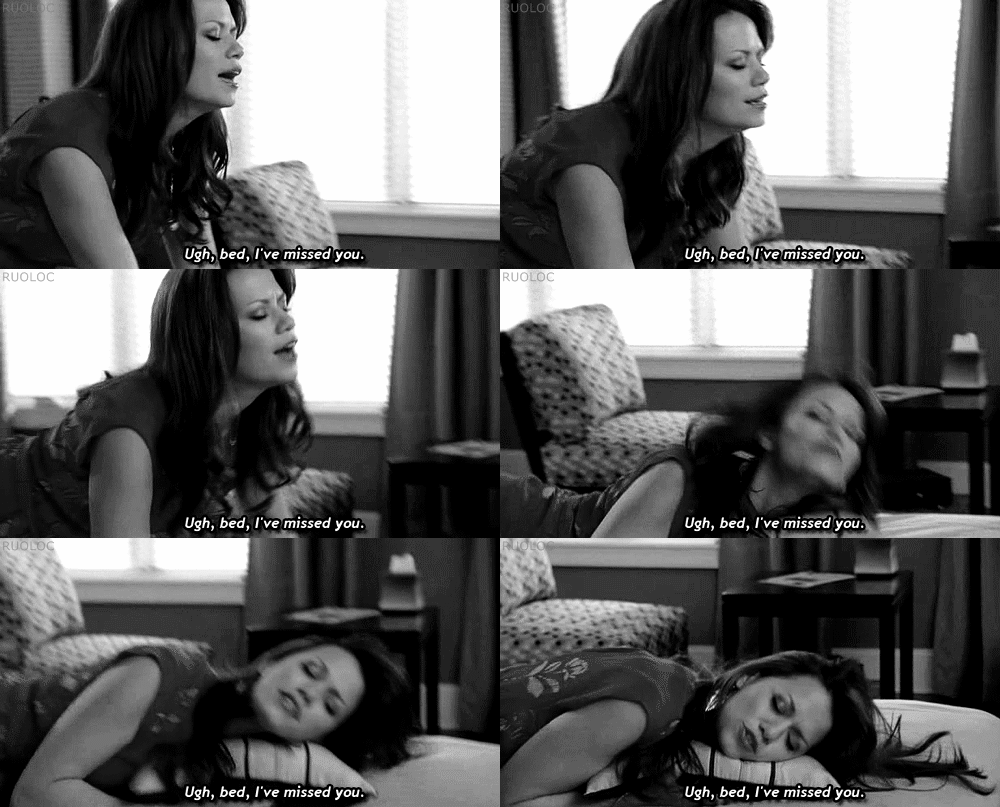 |
| We were BFFs, bed and I. |
Soon enough, I started sleeping through class. I would set an alarm and wake up seeing that it had been blaring for hours. That's weird, I thought, and set the alarm for different frequencies, different volumes. I would sleep through most of them. I started sleeping later and later in the mornings, and taking naps earlier and earlier. And for longer. I missed more and more class. I got farther behind, try to catch up, and get really quickly overwhelmed and want to take a nap. And the more class I missed, the more overwhelmed I got. And the more overwhelmed I got, the more I kept on napping. And the more I napped, the more I felt like I couldn't leave my bed. I felt stuck there. It was comfortable, and warm, and sleeping felt so good. I felt high off sleep.
I don't remember when the weird crying spells started. I would go to class and just come back home and randomly cry. I wasn't even crying about anything in particular -- nothing that I recognized, anyway. I wasn't particularly sad, and I didn't cry because I was triggered by anything specific I would have a good day in class and then just come home and burst into tears and sleep. Well, that's weird, I would think, but I attributed it to PMS. Or stress. Or maybe it was the zoloft? But between debilitating anxiety and a few crying jags here and there, I'd take the crying jags. I made a mental note to call the doctor -- after I took a quick nap.
 |
| Crying, but also thinking about what to eat for dinner at the same time. |
Crying takes a lot out of you. I'd come home, cry for no reason, get super exhausted from crying, and take another four-hour nap. I spent a few months like that, and suddenly I realized I wasn't getting out of bed much at all. And showering? That required you to stand. For a long time. Homie don't play that. I was tired. From crying. Who had the energy to stand? Sure, my hair looked greasy as hell, but who did I have to impress? Who cared? Washing my hair would require lifting my arms, and my arms were tired. I'd take a shower later -- right after a quick cat nap.
Slowly, it progressed. More naps, more crying, less socializing, less leaving the apartment. But I wasn't having anxiety attacks anymore, so it was all good!
Depression is so full of shame. I don't remember when, or why, but I very slowly became morbidly fascinated with death. It was confusing -- I wasn't suicidal. I didn't want to die. I loved life. I was happy -- aside from the random crying jags. I was excited to get married in a few short months -- if I had the energy to make it down the aisle, that is. But for whatever reason, I wanted to know what death felt like. What it would look like. What I would look like, if I died. How would I do it, if I could choose? It wasn't an obsession at first. Just a casual curiosity. I found myself mulling over it more and more. What would happen to me? I mean, physically? If I hanged myself, how would my face look? Bruised? Bloated? These thoughts disgusted and shamed me -- even now, they disgust and shame me. I didn't (and still don't) want anyone to think I was weird, that I was deviant. I didn't want anyone to think I was unhappy or planning to die. I wasn't. But I just kept thinking about it. What would people think if they knew I was imagining myself hanging in my bathroom? If I told someone, would they have me committed? Would I get put on some list? Would they "flag" my medical file? (Is that a thing?) I didn't want to find out. I tried to push the thoughts out of my head. It didn't matter anyway, I told myself. I wasn't suicidal. I didn't want to die. I just ... wanted to imagine that I was dead.
Soon, it was all I could think about. I would have Googling sessions that lasted for hours, when I was supposed to be writing papers or studying, where I would just google graphic images of plane crashes. I didn't like these images -- I just wanted to see them. It was like a little game -- what was the most graphic image I could view, without wanting to shut down my computer? I didn't get very far, admittedly. I was terrified of gore. But the non-gory stuff I was all over. For hours, I listened to cockpit recordings of planes that had gone down. I wanted to hear the pilot's last words. I wanted to imagine how it felt. How did it feel to die? How did the pilots feel in those last minutes, knowing that death was inevitable? I had heard, in my own family, of people beckoning toward the sky in their last moments before dying. Had the people on these planes experienced that too? The cockpit recordings disgusted me, calmed me, and thrilled me, all at once.
I googled 9/11 a lot. I listened to 911 dispatches. I was horrified. But I kept seeking it out. I kept imagining myself on those planes. I omitted this when I saw my therapist -- I knew it wasn't really considered a suicidal ideation unless I had a plan to kill myself. And I didn't. Not exactly. Did I? I mean, I had thought about it a lot. And I had decided that hanging -- no, pills -- would be the way to go. But I didn't want to die. Did I? I mean, I didn't want to die, but I also spent a lot of time thinking about death. And I didn't feel sad ... but I also spent a lot of time crying inconsolably. It was all just very overwhelming. And you know what helped that overwhelming feeling? Naps.
I don't know if I had a "bottom" -- some low point that made me realize I needed to get help. But I remember one day I googled the phrase I can't stop thinking about suicide and a suicide survival forum popped up. I made a username and posted on it. Please help me, I posted. I'm not suicidal, I don't think, but I keep thinking about suicide. I can't stop. I can't think about anything else. I can't get out of bed. Does this mean I'm suicidal? I don't want to die, but I just can't stop thinking about it. What do I do?
The response was overwhelming: You're depressed, dummy. Get to the doctor. NOW.
And I did.
Wednesday, February 12, 2014
So what the hell is new lately?
1. Henry is almost one. I cannot comprehend how the little person who I just had inside me is now scooting across the floor, upending my laundry baskets, and yelling at the top of his lungs.
I continue to be amazed at his progress. No, he can't walk yet. He probably won't for a while -- we need to get his feet straightened out which can't happen for a variety of reasons until he's eighteen-ish months. But damned if he doesn't get where he needs to go -- scooting, rolling, and almost crawling. He sits up unassisted, he can get up on his hands and knees and rock back and forth, he scoots, and he can get from laying down to sitting without any help from anyone. No cognitive delays and barely any physical delays, which is downright astounding considering he was supposed to be paralyzed.

I know. I know. I feel like I am always harping on that. I feel like every other word out of my mouth is HE WAS SUPPOSED TO BE PARALYZED!!!! THE DOCTORS SAID HE'D NEVER MOVE AND NOW HE DOES OMG OMG!!! So I apologize for being a broken record. But when the doctor sits you down and tells you that your kid is paralyzed -- your life changes. Your entire worldview changes. And so every time Henry gets up on his hands and knees, or scoots from one place to another, it feels like this huge victory because multiple people had told us he wouldn't be able to do that exact same thing.
Every SINGLE time he meets a milestone, I judo-chop the air with glee. He did it. He's doing it. He's doing exactly what you said he wouldn't do.
And that is pretty darn inspiring.
2. I'm going to the Edel Gathering!!! When I first heard about the Edel Gathering -- a two-day getaway (I like to call it a "conference" so it sounds like I'm extremely busy and important) for Catholic ladies featuring a dream team of Catholic bloggers and authors -- I immediately got a nerd boner. Cocktails with a bunch of fellow Catholic ladies? Two days away from my kids? Talks and toasts from my favorite bloggers?! KARAOKE AND A CRAZY SHOE CONTEST??!?!?!?!?!?!?! I almost started salivating with desire.
Unfortunately, the prospect of going was so far off my radar that I literally wouldn't allow myself to think about it, lest I get too sad. The gathering is in Austin, Texas (We live in Chicago), and, oh yeah, I'm poor as shit. But then.
THEN.
Lou filled out our tax return a few weeks ago and thanks to our meager salary and our two babies, we are getting a ton of money back. Most is going to our student loans. But a modest amount is for us to splurge with. We hardly ever splurge, and we've had a ridiculously stressful year, so we decided to go for it. Lou is buying some original art. And I staked out the Edel website all morning and bought tickets as soon as they went live. Our splurge money should just barely cover the cost of a conference ticket, one round trip flight, and a delicious gin and tonic that I will nurse the entire night. I am unbelievably excited to go. And if you read this and plan on going, hit me up on Facebook so I can force you to hang out with me at the conference.
3. June. Having a two-year-old is my favorite thing in the world. Sure, it's trying. I haven't gotten proper sleep in months since my particular two-year-old won't sleep unless she's on my pillow with her nose pressed up against mine. Two year olds are relentless, and mine specifically has no understanding of why she can't have cookies and goldfish crackers for every single meal of the day, and she physically takes my face in her hands and turns it toward her when she thinks I've been looking at Henry a few seconds too long. I mean, it's darling, but it's frigging exhausting too.
But aside from the constant attention she demands, my two year old is a delight. I swear I spend a third of the day wanting to rip out my hair and the rest getting snuggles, hugs, and laughing at the ridiculous things that come out of her mouth. Such as:
June: Mommy, what this book say?
Me: The title is, "The Naked and the Dead."
June: NAKED?! NAKED?! WHAT?! NO!
[opens it stealthily, closes it immediately]
June: I saw a bum.
Me: Do you think you'll be a doctor when you grow up, June?
June: Nah. I just be a pretty lady.
Me: June, can you hold my hand in the parking lot, please?
June: Nah. I good.
June: Mommy, Jake say 'shut up' and 'stupid.'
Me: Oh, that's inappropriate. We don't say those words.
June: Mommy, Barney say 'shut up' and 'stupid.'
Me: He did, huh? Well those are rude words. Tell Barney not to say those words.
June: Mommy, daddy say 'shut up' and 'stupid'.
Me: Really? Well that wasn't very nice. Thank you for telling me.
June: Mommy...Shut Up and Stupid said 'shut up' and 'stupid.'
Me: I think you're just trying to get away with saying 'shut up' and 'stupid.'
June: .... shut up.
June [to a dog that got close to her face]: Excuse me. I need some space.
Her favorite thing right now is to change into her Monsters, Inc. pajamas and watch "Monsters, Inc" in the basement with her daddy after he gets off work. At least once a day she asks to do a "craft," which consists of either cutting up pieces of paper (just sitting and cutting random shapes) or mixing snow and chocolate milk mix in a big bowl and eating it with a spoon. She loves puzzles. Blocks. She adores watching TV, which I let her do a fair amount of since she does it so darn interactively. She can quote whole snippets of dialogue from her favorite cartoons and knows pretty much every nursery rhyme, thanks to Barney. Basically, if she's drawing, doing a "craft," watching Adventure Time, or "helping" me clean, she's a happy girl.
And as long as she's asleep by 730, I'm a happy mama.
I continue to be amazed at his progress. No, he can't walk yet. He probably won't for a while -- we need to get his feet straightened out which can't happen for a variety of reasons until he's eighteen-ish months. But damned if he doesn't get where he needs to go -- scooting, rolling, and almost crawling. He sits up unassisted, he can get up on his hands and knees and rock back and forth, he scoots, and he can get from laying down to sitting without any help from anyone. No cognitive delays and barely any physical delays, which is downright astounding considering he was supposed to be paralyzed.
I know. I know. I feel like I am always harping on that. I feel like every other word out of my mouth is HE WAS SUPPOSED TO BE PARALYZED!!!! THE DOCTORS SAID HE'D NEVER MOVE AND NOW HE DOES OMG OMG!!! So I apologize for being a broken record. But when the doctor sits you down and tells you that your kid is paralyzed -- your life changes. Your entire worldview changes. And so every time Henry gets up on his hands and knees, or scoots from one place to another, it feels like this huge victory because multiple people had told us he wouldn't be able to do that exact same thing.
Every SINGLE time he meets a milestone, I judo-chop the air with glee. He did it. He's doing it. He's doing exactly what you said he wouldn't do.
And that is pretty darn inspiring.
2. I'm going to the Edel Gathering!!! When I first heard about the Edel Gathering -- a two-day getaway (I like to call it a "conference" so it sounds like I'm extremely busy and important) for Catholic ladies featuring a dream team of Catholic bloggers and authors -- I immediately got a nerd boner. Cocktails with a bunch of fellow Catholic ladies? Two days away from my kids? Talks and toasts from my favorite bloggers?! KARAOKE AND A CRAZY SHOE CONTEST??!?!?!?!?!?!?! I almost started salivating with desire.
 |
| I will be VERY upset if I can't find an exact replica of these for the crazy shoe contest. |
THEN.
Lou filled out our tax return a few weeks ago and thanks to our meager salary and our two babies, we are getting a ton of money back. Most is going to our student loans. But a modest amount is for us to splurge with. We hardly ever splurge, and we've had a ridiculously stressful year, so we decided to go for it. Lou is buying some original art. And I staked out the Edel website all morning and bought tickets as soon as they went live. Our splurge money should just barely cover the cost of a conference ticket, one round trip flight, and a delicious gin and tonic that I will nurse the entire night. I am unbelievably excited to go. And if you read this and plan on going, hit me up on Facebook so I can force you to hang out with me at the conference.
 |
| Literally. So. Excited. Somebody hold me. |
3. June. Having a two-year-old is my favorite thing in the world. Sure, it's trying. I haven't gotten proper sleep in months since my particular two-year-old won't sleep unless she's on my pillow with her nose pressed up against mine. Two year olds are relentless, and mine specifically has no understanding of why she can't have cookies and goldfish crackers for every single meal of the day, and she physically takes my face in her hands and turns it toward her when she thinks I've been looking at Henry a few seconds too long. I mean, it's darling, but it's frigging exhausting too.
But aside from the constant attention she demands, my two year old is a delight. I swear I spend a third of the day wanting to rip out my hair and the rest getting snuggles, hugs, and laughing at the ridiculous things that come out of her mouth. Such as:
June: Mommy, what this book say?
Me: The title is, "The Naked and the Dead."
June: NAKED?! NAKED?! WHAT?! NO!
[opens it stealthily, closes it immediately]
June: I saw a bum.
Me: Do you think you'll be a doctor when you grow up, June?
June: Nah. I just be a pretty lady.
Me: June, can you hold my hand in the parking lot, please?
June: Nah. I good.
June: Mommy, Jake say 'shut up' and 'stupid.'
Me: Oh, that's inappropriate. We don't say those words.
June: Mommy, Barney say 'shut up' and 'stupid.'
Me: He did, huh? Well those are rude words. Tell Barney not to say those words.
June: Mommy, daddy say 'shut up' and 'stupid'.
Me: Really? Well that wasn't very nice. Thank you for telling me.
June: Mommy...Shut Up and Stupid said 'shut up' and 'stupid.'
Me: I think you're just trying to get away with saying 'shut up' and 'stupid.'
June: .... shut up.
June [to a dog that got close to her face]: Excuse me. I need some space.
 |
| Precious baby. |
Her favorite thing right now is to change into her Monsters, Inc. pajamas and watch "Monsters, Inc" in the basement with her daddy after he gets off work. At least once a day she asks to do a "craft," which consists of either cutting up pieces of paper (just sitting and cutting random shapes) or mixing snow and chocolate milk mix in a big bowl and eating it with a spoon. She loves puzzles. Blocks. She adores watching TV, which I let her do a fair amount of since she does it so darn interactively. She can quote whole snippets of dialogue from her favorite cartoons and knows pretty much every nursery rhyme, thanks to Barney. Basically, if she's drawing, doing a "craft," watching Adventure Time, or "helping" me clean, she's a happy girl.
And as long as she's asleep by 730, I'm a happy mama.
Subscribe to:
Posts (Atom)